
Introduction
Plants need light to grow, but does that mean they should receive light all day and night? If you grow houseplants indoors or use LED grow lights for seedlings, you may have wondered whether turning the lights off at night actually matters.
The answer is yes for most plants. Darkness is a natural part of a plant’s daily cycle, and many species use the length of the night to regulate flowering and other important developmental processes. Keeping grow lights on around the clock is therefore not a good default for most indoor gardens.
However, plants do not all respond to darkness in the same way. Some are sensitive to the length of uninterrupted nighttime darkness, while others are less affected by day length when it comes to flowering. Understanding this difference can help you create a more suitable lighting routine for your plants.
Quick Answer: Do Plants Need Darkness?
Yes, most plants benefit from a regular period of darkness every day. Many indoor plants should not be exposed to grow lights for 24 hours continuously.
Darkness matters for three main reasons:
- Plant development: Plants use light and dark cycles as signals that help regulate growth and development.
- Flowering: Some plants need long, uninterrupted nights to produce flowers, while others flower in response to shorter nights.
- Natural daily rhythms: Plants have biological processes that respond to the recurring cycle of day and night.
For many indoor plants, a practical starting point is to provide around 12–14 hours of light per day, allowing the remaining hours to be dark. Some plants need different schedules, so adjust this according to the species and its growing conditions.
Light vs. Darkness: What Is the Difference?
Light and darkness serve different roles in plant development. Understanding those roles helps explain why simply leaving a grow light on for longer is not always beneficial.
| Factor | During Light | During Darkness |
|---|---|---|
| Photosynthesis | Light supplies the energy needed for photosynthesis | Photosynthesis generally stops when usable light is absent |
| Respiration | Continues | Continues |
| Flowering signals | Contributes to the plant’s perceived day length | Night length can trigger flowering in sensitive species |
| Growth and development | Supplies energy for growth | Supports ongoing metabolism and responses to the daily cycle |
| Plant response | Depends on intensity, duration, and light quality | Depends on species and the length of uninterrupted darkness |
One important distinction is that plants do not stop respiring at night. Respiration occurs both day and night, using stored sugars to support cellular processes. Darkness is not simply a period when a plant rests or recovers from photosynthesis.
Why Do Plants Need Darkness?
1. Plants Respond to the Day-and-Night Cycle
Plants do more than respond to how bright their surroundings are. Many can also respond to how long light and darkness last over a 24-hour period.
This response is called photoperiodism. It helps certain plants coordinate flowering and other developmental changes with seasonal conditions.
For example, a plant may use the length of the night as a signal that the season is changing. In nature, these signals can help plants time flowering or prepare for seasonal changes.
The response differs between species. Some plants depend strongly on the duration of darkness, while others are comparatively insensitive to day length for flowering.
2. Darkness Can Help Trigger Flowering
One of the most important reasons to maintain a consistent dark period is that some plants use uninterrupted darkness as a flowering signal.
Plants are often grouped into three categories according to their flowering responses:
- Short-day plants: These generally flower when the night exceeds a species-specific length. They are also called long-night plants.
- Long-day plants: These generally flower when nights are short enough, or days are long enough, to meet their requirements.
- Day-neutral plants: Their flowering is not strongly controlled by day length, although other environmental factors still matter.
Poinsettias and chrysanthemums are examples of plants whose flowering can be influenced by long, uninterrupted nights. African violets are an example of a plant that can respond to longer days.
These categories do not mean that every plant in a group follows an identical schedule. The critical duration varies by species and sometimes by variety.
3. Artificial Light at Night Can Disrupt Plant Signals
A plant does not necessarily interpret nighttime lighting in the same way that a person does. Even when an artificial light seems dim to us, it may affect a light-sensitive plant if its intensity, wavelength, and timing are sufficient.
Research and horticultural guidance show that nighttime lighting can interfere with seasonal plant responses. Depending on the species, this may affect flowering, leaf drop, dormancy, or seed germination.
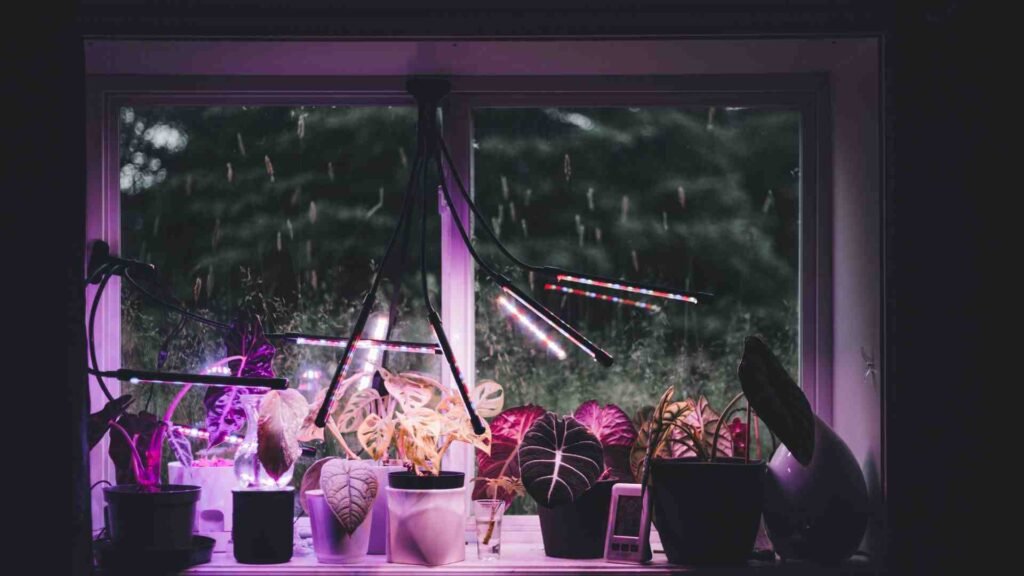
Outdoor plants may be exposed to artificial light from streetlights, security lights, porch lights, and illuminated buildings. Indoor plants may experience similar interruptions when room lights or grow lights remain on late into the night.
This does not mean that every plant will be harmed by every nearby light. The effect depends on the species and the amount of light reaching the plant. Still, maintaining a reasonably consistent day-and-night schedule is a sensible starting point for most home gardeners.
What Happens If Grow Lights Stay On 24 Hours?
Leaving grow lights on continuously may seem like an easy way to give plants more light and encourage faster growth. However, more lighting time does not automatically mean healthier plants.
Most home gardeners should avoid running grow lights for 24 hours a day. Many plants develop better with a regular dark period, and some require uninterrupted darkness to flower properly. University extension guidance generally recommends no more than 16 hours of light per day for most indoor plants. (University of Maryland Extension)
Continuous lighting can create several problems:
- Disrupted flowering: Light-sensitive plants may not flower when their nighttime requirements are interrupted.
- Unbalanced growth: Plants can respond differently to extended light depending on their species and growing conditions.
- Unnecessary electricity use: Running lights overnight may increase energy costs without providing a meaningful benefit.
- Difficulty maintaining a natural routine: A consistent light-dark cycle makes it easier to manage indoor growing conditions.
Not every plant responds identically to continuous light, and some crops can tolerate extended lighting under controlled growing conditions. Nevertheless, 24-hour lighting should not be the default for ordinary houseplants.
Can Room Lights and Streetlights Affect Plants?
Yes, artificial light at night can affect some plants, especially those that use the length of uninterrupted darkness to regulate flowering.
The effect depends on several factors, including light intensity, wavelength, exposure duration, distance, and plant species.
Indoor room lights
If your plants are near a living-room lamp or a bright room that stays illuminated late into the night, the extra light may interfere with flowering in sensitive species.
You generally don’t need to keep your entire home dark for your plants. Instead, avoid directing bright lights at sensitive plants throughout the night, particularly when you’re trying to encourage flowering.
Streetlights and security lights
Outdoor plants can receive artificial light from streetlights, porch lights, floodlights, and security lamps.
This can be particularly relevant for plants that need long, uninterrupted nights to flower. A plant growing directly beneath a bright security light may experience a different effective day length from a similar plant growing in a darker location.
If a flowering plant isn’t blooming as expected, consider whether artificial nighttime lighting could be one contributing factor. Other causes, including plant maturity, temperature, nutrition, and overall light intensity, may also be involved.
Do you need complete darkness?
Not necessarily. The required darkness depends on the plant and its sensitivity to light. A dim light that has little effect on one species may be more significant for another.
For plants with specific flowering requirements, keeping the nighttime period consistently dark is a practical precaution.
How Much Darkness Do Indoor Plants Need?
There isn’t one universal dark-period requirement for every plant. The right schedule depends on the species, its growth stage, available sunlight, and whether you’re growing foliage, seedlings, or flowering plants.
For general indoor gardening, many growers use approximately 12–14 hours of total light per day as a starting point. Some seedlings need longer lighting periods, while flowering plants may require specific day-length conditions. (University of Minnesota Extension)
Use these guidelines as a starting point:
- Foliage houseplants: Provide suitable light during the day and a consistent dark period overnight.
- Seedlings: Follow the requirements of the crop and seed-starting setup rather than assuming that longer lighting is always better.
- Flowering plants: Check whether the species is sensitive to day length before changing its lighting schedule.
- Outdoor garden plants: Allow natural day and night conditions whenever practical, while considering the effect of nearby artificial lighting.
Remember that total light exposure includes both sunlight and artificial light. If a plant receives several hours of sunlight and then additional grow-light exposure, count both when planning its daily routine.
How to Give Your Plants a Healthy Light-Dark Cycle
You don’t need a complicated setup to manage nighttime darkness. A few practical steps can make your indoor growing routine more consistent.
1. Use a timer for grow lights
A plug-in timer or a grow light with a built-in timer can switch lights on and off automatically.
This helps prevent accidental overnight lighting and keeps the schedule consistent when you’re busy or away from home.
2. Keep the schedule consistent
Try to switch lights on and off at roughly the same times each day. Consistency is especially important for plants whose flowering depends on day length.
3. Check nearby light sources
If a plant isn’t flowering as expected, check whether room lights, outdoor floodlights, or streetlights are illuminating it at night.
For particularly light-sensitive plants, relocating the plant or reducing nighttime exposure may help.
4. Adjust for the plant species
Don’t assume that every plant needs exactly 12 hours of light and 12 hours of darkness. Look up the requirements of the plant you’re growing, especially if it’s a flowering species.
5. Don’t compensate for weak light by leaving lights on indefinitely
If a plant is growing slowly or becoming leggy, the issue may be inadequate light intensity, poor light placement, or another growing condition. Extending the lighting period isn’t always the best solution.
FAQs
Do plants grow at night?
Yes. Plants continue cellular respiration and other metabolic processes at night. Growth patterns vary by species and environmental conditions, but darkness does not mean all plant activity stops.
Can I leave my grow light on overnight?
For most ordinary houseplants, it’s better to switch grow lights off for a regular dark period. Some controlled growing systems use extended lighting for specific crops, but that doesn’t make continuous light appropriate for every plant.
Do plants need 12 hours of darkness?
Some plants do well with a schedule close to 12 hours of light and 12 hours of darkness, but this isn’t a universal requirement. Certain plants need longer nights to flower, while others respond to different day lengths.
Will plants die if they don’t get darkness?
A plant won’t necessarily die after a single unusually long lighting period. However, continuous light can interfere with normal development in some species and may cause problems under certain conditions. A regular dark period is the safer general practice for indoor gardening.
Do plants need darkness if they receive sunlight during the day?
Yes, most plants benefit from a normal night period even when they receive sufficient natural sunlight. Daytime sunlight doesn’t remove the role of darkness in plant development and flowering responses.
Can artificial light stop plants from flowering?
It can interfere with flowering in light-sensitive plants if it disrupts the required dark period. The result depends on the species and the amount, timing, and type of light.
Final Thoughts
Plants need more than just enough light to photosynthesize. For most species, a regular light-dark cycle is also an important part of healthy development.
If you grow houseplants under LED lights, use a timer, avoid leaving the lights on all night by default, and check the requirements of flowering plants that respond to day length. Also consider whether bright room or outdoor lights are interrupting their nighttime darkness.
The main lesson is simple: give plants enough appropriate light, but don’t assume that more hours are always better. A suitable and consistent day-and-night cycle is a better starting point for most home gardens.